Symptom Tracking
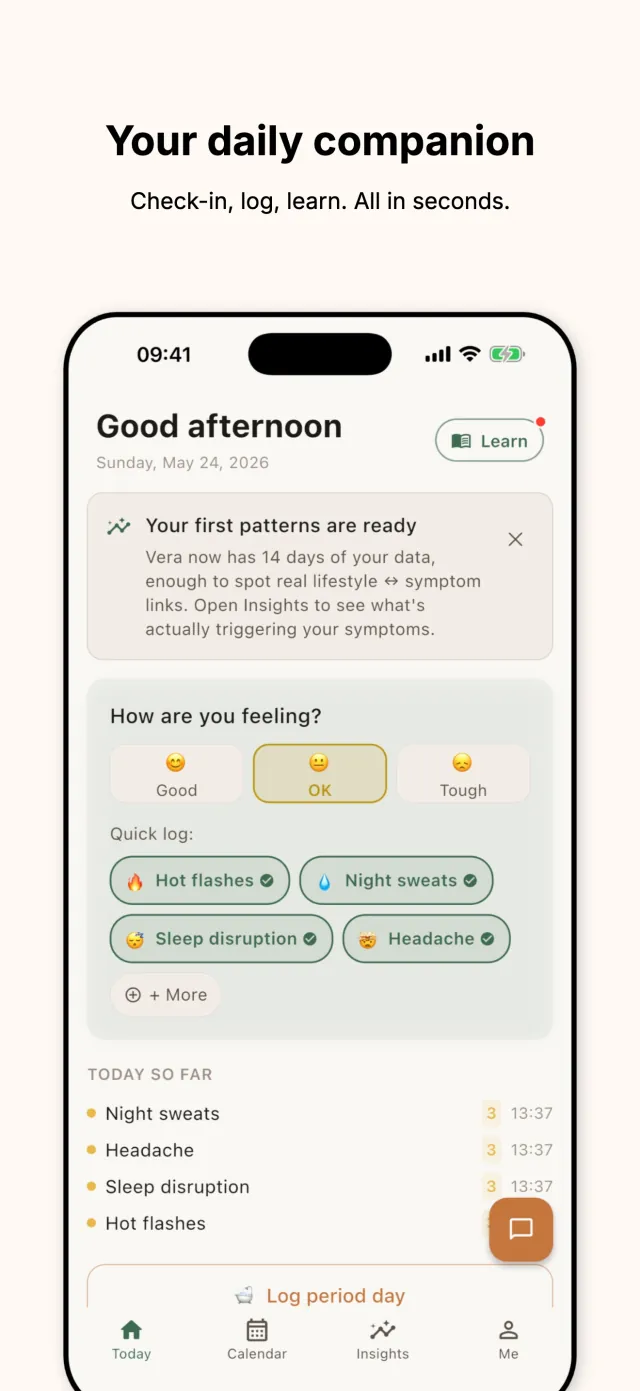
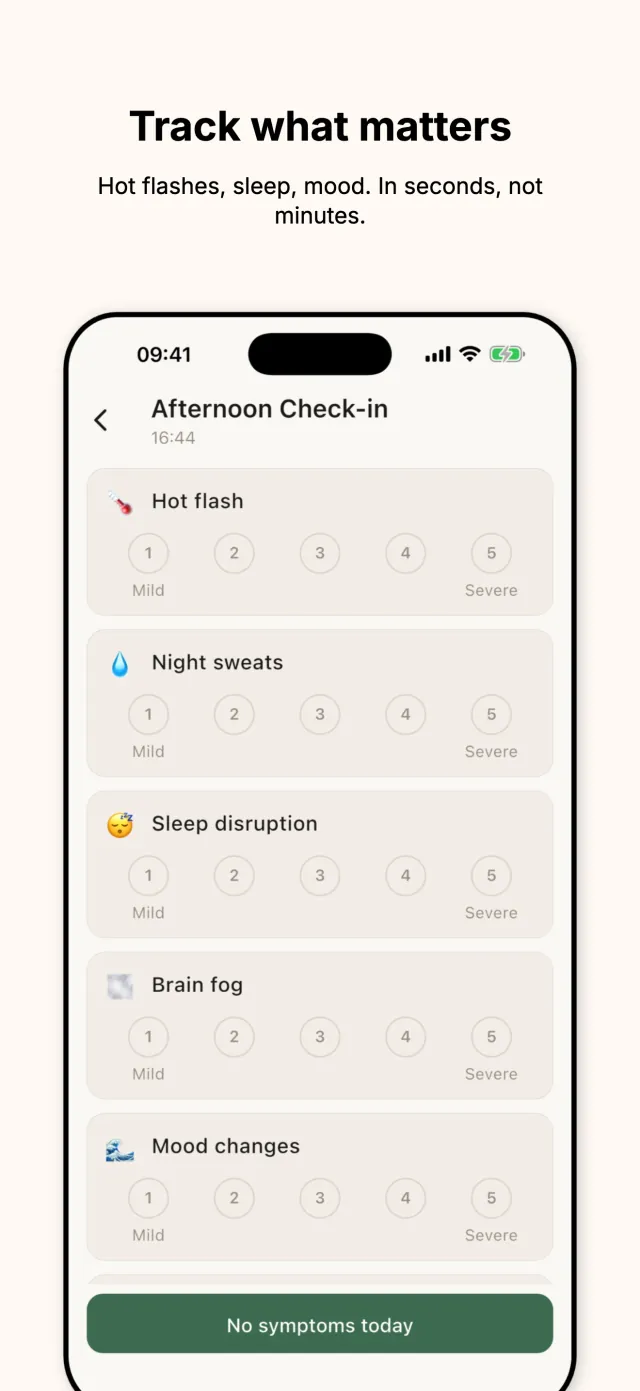
Log 10+ menopause symptoms (hot flashes, night sweats, sleep quality, fatigue, mood, brain fog, joint pain) with severity and functional impact. Fast daily entry, no friction.

Menopause companion
Vera is a private, warm companion for the years that matter. Track symptoms, see your patterns, own your data.
Available on the App Store and Google Play 9 languages
What it does
Menopause is a years-long transition, and the symptoms are rarely simple. Hot flashes, disrupted sleep, fatigue, mood shifts, joint pain. They overlap, interact, and change over time. Most people navigate this without a clear picture of what is happening in their own body. Vera exists to give them that picture.
Vera is for women in perimenopause or postmenopause who want to understand their patterns, whether they are tracking symptoms for themselves, working with a healthcare provider, or adjusting an HRT regimen and trying to see what is actually helping. It runs on iPhone and Android, stores data locally by default, and is available in 9 languages at launch.
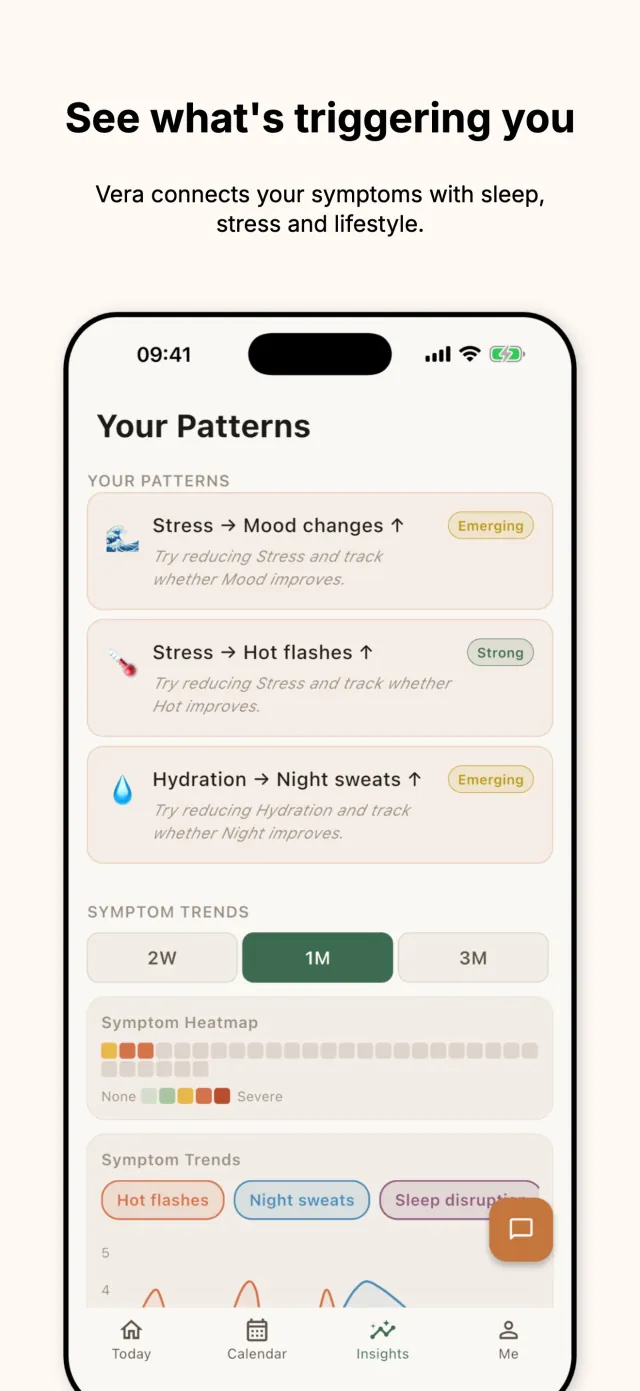
The design principle is calm specificity. Vera does not flood you with notifications or gamify logging. It surfaces the connections that take weeks of data to become visible: the relationship between sleep quality and next-day fatigue, the way a diet change correlates with hot flash frequency. and presents them without noise.
Key features
Each feature addresses a concrete gap in how menopause is typically managed, not tracked for its own sake.
Log 10+ menopause symptoms (hot flashes, night sweats, sleep quality, fatigue, mood, brain fog, joint pain) with severity and functional impact. Fast daily entry, no friction.
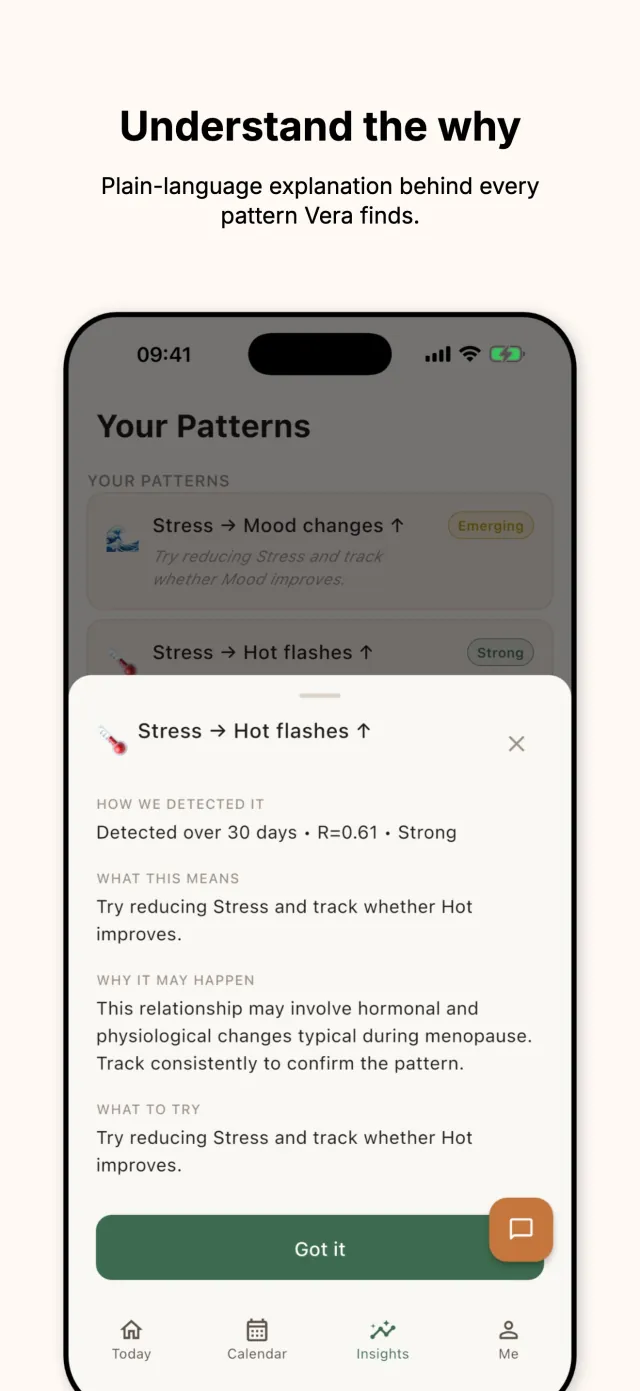
A local correlation engine surfaces meaningful connections: how sleep affects fatigue, how cycle phase relates to hot flash frequency. AI interprets the correlations in plain language, on-device first.
Log hormone therapy doses, schedules, and adherence alongside symptom data. See whether changes in your regimen correspond to changes in how you feel, in your own data, not averages.
Track periods and cycle phases during perimenopause. Insights adapt to where you are in the transition. Correlations are computed with cycle phase as a dimension, not averaged away.
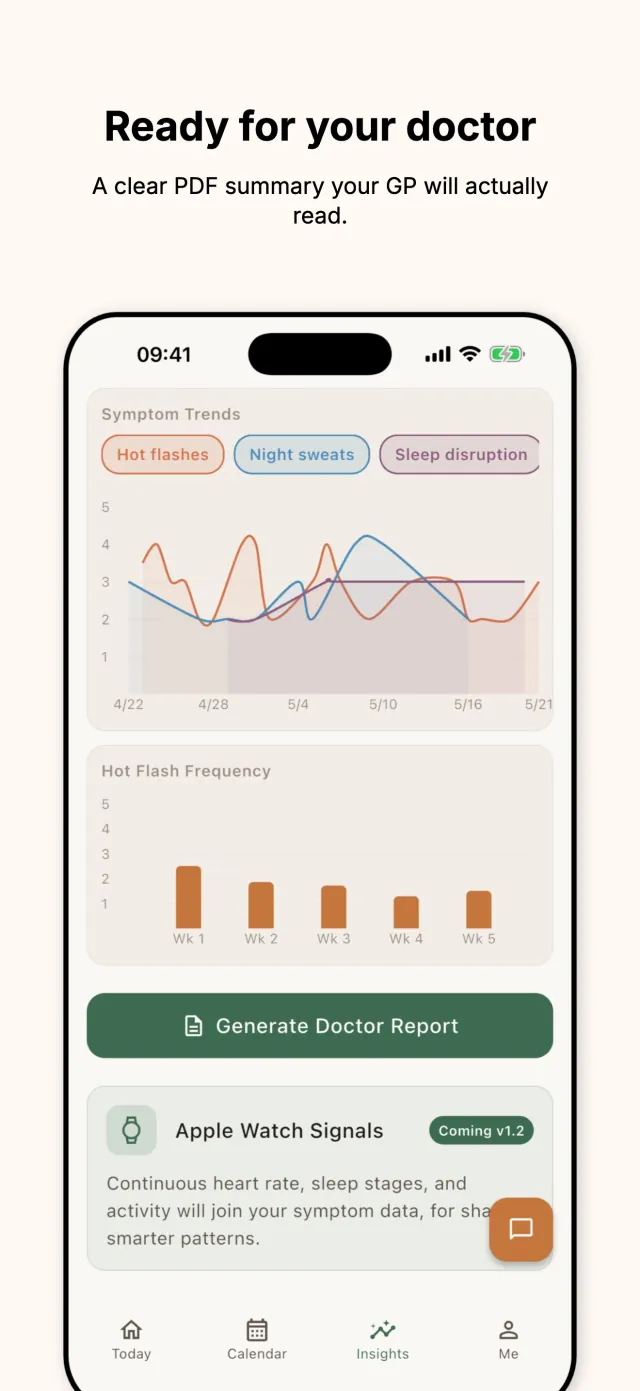
Export a clinical-format PDF covering symptom trends, correlation findings, medication history, and key statistics over any date range. One tap to share before an appointment.
Optional backup uses AES-GCM with a key derived via Argon2id from a passphrase only you know. We cannot read a backup, and neither can anyone who intercepts it.
Under the hood
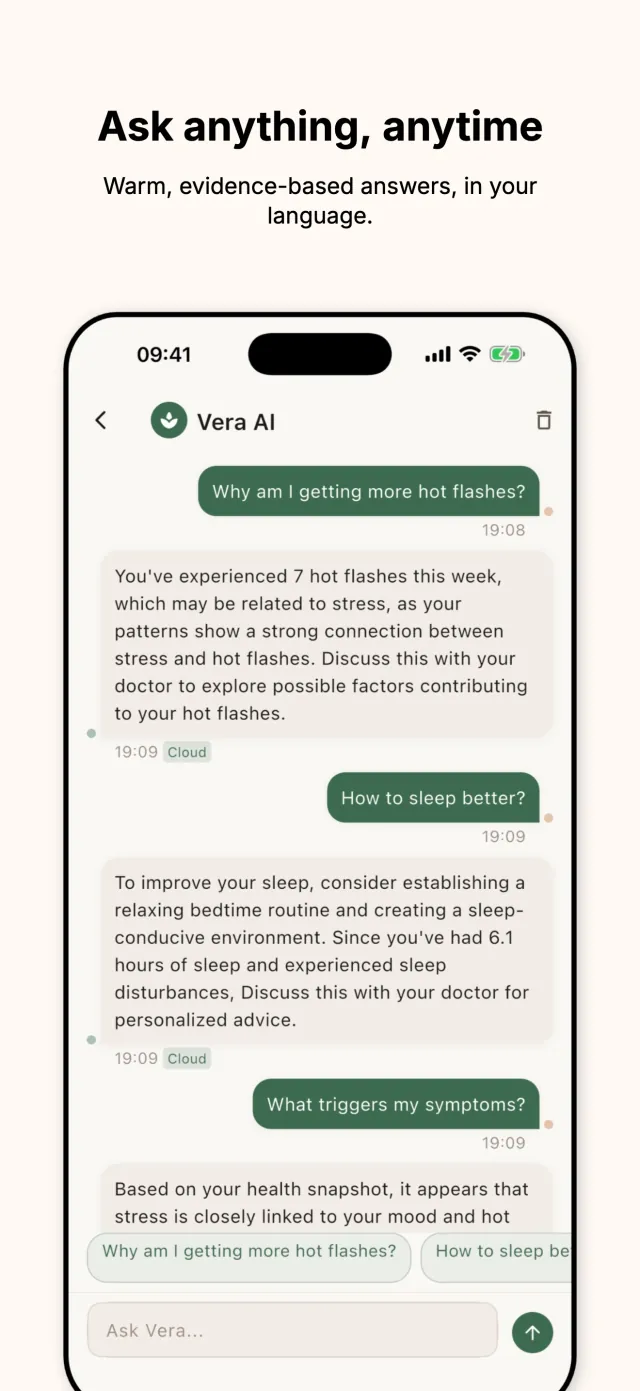
Vera uses a three-tier AI architecture. On devices that support on-device inference (Apple Intelligence on iPhone 15 Pro and newer, Gemini Nano on supported Android), insight generation runs entirely locally: private, offline, and free. When on-device AI is unavailable, a cloud cascade picks up the gap: Groq is tried first, then Google Gemini, then OpenAI, in order of cost. The cascade stops at the first successful response. Users who prefer to keep all processing local can disable cloud AI in Settings; a set of localized static templates serves as the final fallback. The correlation engine itself, which finds statistically meaningful connections between lifestyle factors and symptoms, always runs locally on the device, with no external calls.
Local data lives in a Drift SQLite database, encrypted at rest via
flutter_secure_storage. Optional Firestore sync is available for
multi-device access, but it is genuinely optional. The app is fully functional
without a network connection. The optional encrypted backup uses
AES-GCM with a key derived via Argon2id from a
passphrase only the user holds. State management runs on Riverpod 2.x with
async notifiers; heavy computation runs in background isolates so the UI
thread stays free.
Vera launches in 9 languages: English, German, Spanish, French, Italian, Japanese, Korean, Portuguese (Brazil), and Chinese Simplified. Localization covers not only UI strings but insight templates, symptom names, and PDF report copy, so the clinical export reads naturally in the language the user works in. Font scaling is capped at 1.3x system scale to keep report layouts stable across accessibility settings.
Privacy by design
On-device by default
Symptom logs, correlations, and AI insights run locally. Health data does not leave the device unless the user explicitly enables backup or sync.
Cloud AI is opt-out, not opt-in
Cloud AI is on by default for devices without on-device model support. Users can disable it in Settings at any time. Localized templates produce insights with no network calls.
Encrypted backup, user-owned key
Backup files are encrypted with AES-GCM before leaving the device. The key is derived from a passphrase only the user knows. We cannot decrypt a backup.
No tracking, no advertising, no data sales
No analytics pixels, no advertising SDKs, no behavioral profiling. Only crash reporting and aggregate AI usage metrics for cost monitoring are collected.
When cloud AI is used, only patterns are sent
Cloud providers receive aggregate patterns (e.g., "sleep duration correlates with fatigue") and weekly symptom counts, not raw logs, not notes, not identifying information.
How it looks
Six glimpses of tracking, patterns, and reports inside Vera.
Scroll to browse →
Download
Vera is live on iPhone and Android, in 9 languages. Email contact@mightys.dev if you have feedback, or to share what you'd want from a menopause companion.
Also on the App Store Also on Google Play